
Your Thermal Process Has Passed Validation. But Is It Actually Under Control?
Ten successful results. Not a single failure. So what's the problem?
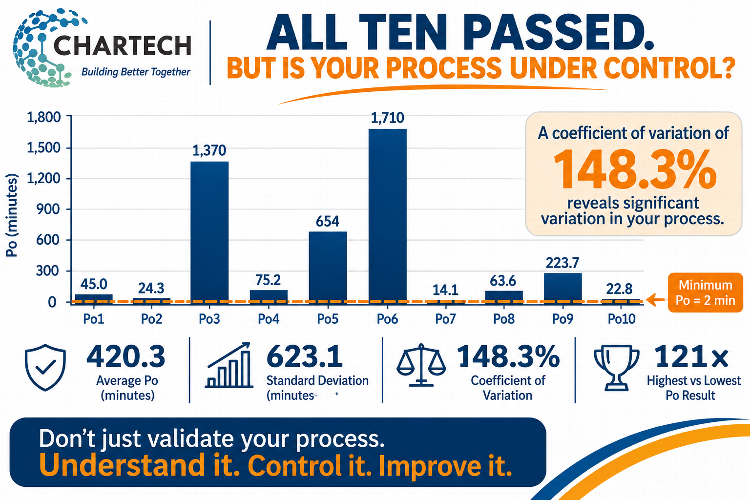
Let's look at the following results from a thermal validation study. These are the Po values (minutes) recorded at the end of the heating process for ten ready meals.
| Po1 | Po2 | Po3 | Po4 | Po5 | Po6 | Po7 | Po8 | Po9 | Po10 |
| 45 | 24.3 | 1370 | 75.2 | 654 | 1710 | 14.1 | 63.6 | 223.7 | 22.8 |
The minimum required Po for this product is 2 minutes.
At first glance, and certainly from a basic audit perspective, everything looks fine.
Every sample has achieved the required minimum Po. The validation has passed, the paperwork is complete and everyone can get on with production.
Right?
Wrong. There is a much bigger story hiding in these results.
What are the results really telling us?
The average Po across these ten samples is approximately 420 minutes.
However, the standard deviation is approximately 623 minutes. That means the standard deviation is around 148% of the average.
In other words, the results are showing enormous variation.
We have one sample achieving a Po of 14.1 minutes and another achieving 1,710 minutes. Both technically pass the minimum requirement, but they tell us very different things about what is happening inside our process.
This is not simply a statistical curiosity. It is a potential indication that the process is not operating consistently.
And that should concern us.
Why should we care if every product passes?
Thermal validation is not just about demonstrating that a minimum lethality has been achieved. It should also help us understand how consistently our process delivers that lethality.
Significant variation could be associated with differences in:
- Initial product temperature.
- Product formulation, composition and physical properties.
- Fill weight, pack dimensions and product distribution.
- Equipment loading patterns and product positioning.
- Heating medium circulation and temperature distribution.
- Operating practices and process control.
Some of these factors may be perfectly legitimate, but others could be symptoms of an unstable or poorly understood process.
The real concern is that ten validation results are being used to give us confidence in production over the next 6–12 months, potentially covering millions of individual units.
If we simply look at whether each result exceeds the minimum Po requirement, we could be overlooking significant opportunities to improve process consistency and control.
And we may be missing problems that only become apparent later through unexpected process deviations, quality issues, microbiological failures, customer complaints or, in the worst circumstances, a product recall.
Passing validation is not the same as having process control
A validation study gives us evidence that a process can achieve the required outcome under the conditions studied.
It does not automatically demonstrate that the process is stable, predictable or operating as efficiently as it could.
There is a big difference.
Imagine achieving the required Po with a substantial safety margin every time. That might appear reassuring, but what is it costing you?
- Excessive processing time.
- Unnecessary energy consumption.
- Reduced production capacity.
- Additional product quality deterioration.
- Potentially avoidable losses in yield.
On the other hand, significant variability means we may not have sufficient understanding of what determines the actual process outcome.
Neither situation should simply be accepted without investigation.
Statistics opens up a different way of looking at thermal processing
This is where statistical process control and a better understanding of process variation become valuable.
Rather than asking just one question:
Did we achieve the required Po?
We should also be asking:
- How much variation exists between samples?
- What factors are driving that variation?
- Are the results consistent across different production conditions?
- Are we delivering significantly more lethality than necessary?
- Can we reduce variation without compromising food safety?
- How much could we improve our energy consumption, yields and production efficiency?
These questions move us away from simply demonstrating compliance and towards genuinely understanding and improving the process.
Of course, reducing variation does not mean reducing the required food safety margin. It means understanding the process well enough to deliver the necessary lethality consistently, without unnecessary overprocessing.
Turning validation data into a business improvement opportunity
At Chartech, we believe there is far more to thermal processing than simply completing a validation study and filing the report away.
We have developed practical review methods that help manufacturers look beyond the headline results, understand the variation within their thermal processes and identify opportunities for genuine continuous improvement.
Combined with the advanced temperature and pressure data logging capabilities of TMI-Orion, we can help manufacturers build a much clearer picture of what is happening inside their retorts and, more importantly, why.
The objective is simple:
Better process understanding. Less variation. Greater control. Improved performance.
Your validation results should be the starting point for understanding your process, not the end of the conversation.
If you want to get more from your thermal processing operation, perhaps it is time to look at your data a little differently.
At Chartech, we help manufacturers move beyond validation towards understanding, control and continuous improvement.
Get in touch to find out how we can help you unlock more value from your thermal processing operation.
Chartech – Building Better Together.