
What's Really Happening in Your Domestic Frifge?
We work hard to control temperatures in food manufacturing. But what happens when the product gets home?
I recently sat in on an online session delivered by Highfield, which included a discussion about Listeria and the ability of domestic refrigerators to maintain temperatures below 5°C.
After watching a rather disappointing game of rugby, I thought, why not put this to the test?
Out came the trusty TMI temperature loggers, and I decided to investigate what was actually happening inside my own fridge.
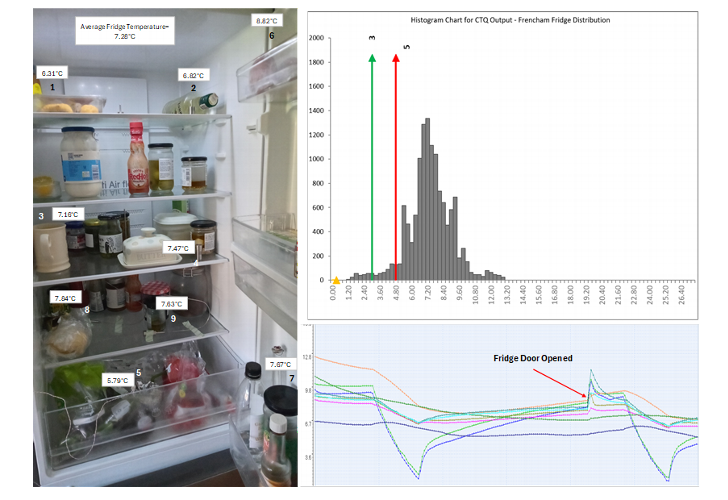
I positioned the loggers in various locations around the fridge and left them recording for an hour. During that time, I opened the fridge door once.
After loading the fridge with the loggers, it took approximately 20 minutes for the temperatures to drop and stabilise.
The results were certainly interesting!
| Location in the Fridge | Average Temperature |
| Vegetable tray |
5.79°C |
| Fridge Average |
7.28°C |
| Fridge Door at the top |
8.82°C |
The figures represent my initial temperature survey and are not a long-term assessment of fridge performance.
My fridge was averaging 7.28°C, with even the coldest location recording 5.79°C. The door was averaging 8.82°C.
So much for keeping everything below 5°C!
Is this an isolated example?
Apparently not.
A little further investigation uncovered some interesting research.
Food Standards Scotland undertook a citizen science project involving 361 households, monitoring domestic refrigerator temperatures over ten days.
The average temperature recorded was 5.17°C, with 55.4% of the refrigerators averaging above the recommended maximum of 5°C.
Interestingly, the average temperature on the top shelf was 5.89°C, compared with 4.45°C on the bottom shelf.
The Food Standards Agency also undertook research involving 65 domestic refrigerators. The average temperature was 5.3°C, with 34 of the 65 refrigerators averaging above 5°C.
It seems my little experiment wasn't quite as unusual as I first thought.
Why does this matter?
Now, before I go any further, I should probably make one thing clear. I am definitely not a microbiologist, and I'm not going to pretend to be one!
My interest here is very much from a thermal processing and process control perspective. However, having spent a considerable amount of time working with food processes, I understand that temperature plays an important role in managing microbial growth, product safety and shelf life.
This is where things get interesting, particularly when we consider Listeria monocytogenes.
Unlike many foodborne pathogens, Listeria can grow at refrigeration temperatures, including below 5°C.
Keeping food cold doesn't necessarily stop Listeria growing; it slows the rate of growth.
As temperatures increase, that growth rate can increase significantly.
For food manufacturers, temperature control is a fundamental part of managing product safety and shelf life.Considerable effort goes into ensuring products are cooled correctly, stored at specified temperatures and maintained within the cold chain.
Some manufacturers work to targets of 5°C, while others have even more demanding requirements of 3°C or below.
But what happens when the consumer takes that product home?
We might have manufactured a product, cooled it correctly, maintained the cold chain and delivered it to the retailer within specification.
But if the consumer's fridge is operating at 7°C or 8°C, a significant proportion of that product's remaining shelf life could potentially be spent at temperatures higher than those used when establishing its shelf life.
That raises an interesting question.
Are we always considering realistic domestic storage conditions when determining the shelf life of chilled products?
Of course, the temperature of the air inside a fridge isn't necessarily the same as the temperature of the food itself. Nor does a short temperature survey tell us how long a product spends at a particular temperature.
But it does highlight why understanding the complete temperature history of a product is important.
A little more than just a fridge thermometer
I appreciate that my experiment was relatively short, and I wouldn't pretend that one hour of temperature recording provides a complete picture of domestic fridge performance.
However, it certainly made me think.
We spend a considerable amount of time in food manufacturing measuring, monitoring and controlling temperatures. We invest in equipment, training and procedures to ensure that products meet their specified requirements.
Yet once those products leave the factory, we have considerably less control over their storage conditions.
Perhaps we should spend a little more time understanding what actually happens at the other end of the supply chain?
Have you ever checked the actual temperature inside your domestic fridge? You might be surprised by what you find.
At Chartech, we help manufacturers move beyond validation towards understanding, control and continuous improvement.
Get in touch to find out how we can help you unlock more value from your thermal processing operation.
Chartech – Building Better Together.
Practical experience. Better process understanding. Continuous improvement.