
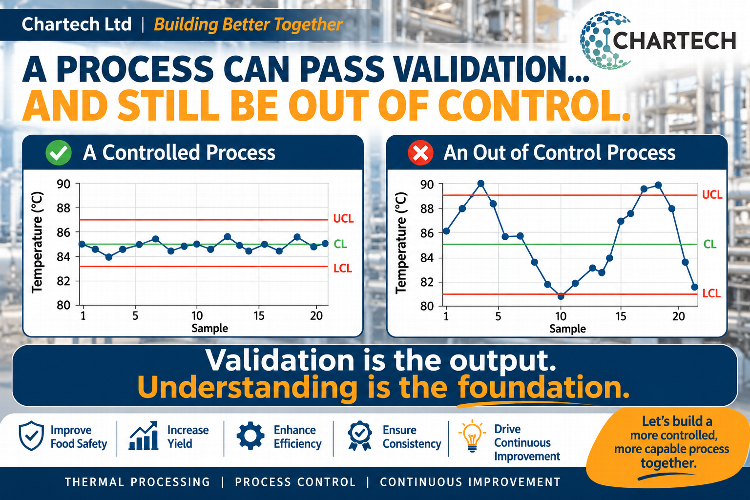
Despite having passed validation, are you still experiencing frequent non-conformances in your daily temperature checks or other critical process measurements?
Passing a validation study doesn't necessarily mean you have a process that consistently delivers the results you want.
If your process isn't genuinely understood, controlled and capable, you will inevitably experience non-conformances. This often results in valuable management and technical resources being spent searching for the root cause of an issue that is, in reality, multi-causal.
Does the following sound familiar?
One day you're being praised for delivering a great performance, and the next you're being questioned about why performance has suddenly deteriorated. The process hasn't fundamentally changed, yet the results tell a very different story.
If this sounds familiar, don't feel disheartened. You're certainly not alone.
The reality is that many processes are validated based on what is observed during the validation exercise. However, what happens on the day doesn't necessarily represent what happens over the following weeks, months or years of production.
A process that isn't stable and predictable will struggle to consistently deliver the scheduled process requirements.
So, where does the problem start?
There are two areas I would look at.
1. A lack of process stability and predictability.
How well do you understand the variables that influence your process? Are they measured, monitored and controlled, or are you simply reacting when something falls outside its expected specification limits?
2. The scheduled process may not adequately reflect real production variation.
Sometimes, the scheduled process or operating parameters are established using conditions observed during validation, without sufficiently understanding the variation that exists across normal production.
This can result in operating limits that are unnecessarily restrictive, frequent deviations and a production team constantly firefighting.
The answer isn't necessarily to relax the limits. It's to understand the process, establish what drives the variation and ensure that the scheduled process and operating controls are appropriate and robust.
Validation is the output; understanding is the foundation
A thermal validation report is an important output of the validation process. But what sits behind that report?
Have you genuinely understood the variables and inputs that influence your process lethality (Fo/Po), product exit temperature and ultimately the quality and safety of your product?
For example, have you considered the influence of:
- Initial product temperature and its variation.
- Fill weights, product formulation and physical characteristics.
- Container dimensions and product geometry.
- Oven/ Tank/ Retort loading patterns and configuration.
- Program and equipment performance along with temperature distribution.
- Heating, holding and cooling characteristics.
- The interaction between these variables and their influence on the final process.
Simply having a validation report doesn't guarantee a smooth-running production process.
If the foundation of that report doesn't adequately account for process variation, stability and the factors influencing performance, the reality on the shop floor can be very different from what the validation report suggests.
And remember, experienced auditors don't just look for a validation report and the name of the company /person who completed it. They want to understand whether the process being operated today reflects the process that was validated.
What does good process understanding actually deliver?
A properly designed and supported validation programme should do much more than satisfy an audit requirement.
When built on a sound understanding of the process, it can become the foundation for:
- Improved audit performance: Clear evidence, robust validation and confidence in ongoing process control.
- Improved yield: Understanding the variables that influence product quality and identifying opportunities to reduce waste.
- Greater efficiency: Reducing unnecessary adjustments, downtime and repeated investigations.
- Consistent quality: Moving away from fluctuating results towards predictable performance.
- Better problem-solving: Giving your team the tools to investigate process inputs rather than simply reacting to the symptoms.
- Continuous improvement: Creating the headroom for your team to look more deeply into the process and identify opportunities that may previously have been overlooked.
Perhaps most importantly, it gives your people the confidence and capability to manage their processes rather than constantly firefight them.
Consistency is what makes the difference.
I remember something one of my managers used to say when I first started in the food industry:
"Anyone can make a mayonnaise, but not everyone can make a consistent and financially viable mayonnaise."
I've always liked that statement because it applies to virtually every manufacturing process.
Making a product that meets specification once isn't necessarily difficult. The real challenge is making it consistently, efficiently and profitably, day after day.
That's where process understanding makes the difference.
How can Chartech help?
At Chartech, we believe there is more to thermal processing than validation reports.
Our nine-step programme for thermal processes (and five-step programme for non-thermal processes) is designed to help manufacturers move beyond simply meeting validation requirements.
We work with your team to understand the current situation, identify the variables influencing performance, establish control, measure capability and develop a sustainable approach to ongoing improvement.
The objective isn't simply to get you through your next audit. It's to give your business the knowledge, tools and internal capability to take control of its processes.
We've already seen companies take up this challenge and start realising the benefits.
Why not join them?
Get in touch with Chartech for an informal conversation about your current processes and how we could help you move from firefighting to understanding, from inconsistency to control, and from validation to continuous improvement.